

Networking for Net Profit: A Playbook for Finnish Companies’ ASEAN Market Entry

Executive Summary
The Association of Southeast Asian Nations boasts a rapidly expanding digital ecosystem and a projected 2026 regional growth rate of 4.5 per cent, making it a critical growth market for Finnish enterprises facing stagnant domestic growth.
This playbook sets up a three-pillar go-to-market approach to help Finnish SMEs navigate the fragmented Southeast Asian trade landscape.
Successful expansion relies on securing domestic funding through institutional organisations, deploying diplomatic networks to gain initial market access, and leveraging sector-agnostic chambers of commerce to build commercial trust.
Executive leadership must define their geographic operational base based on strategic fit, validate export readiness against state-backed priority sectors, and deploy asset-light execution models to leverage local business intelligence.
The ASEAN Canvas Dictates Specific Strategic Roles
The Association of Southeast Asian Nations (ASEAN) comprises countries of great
variety; enterprises must target specific nations based on their precise commercial requirements. The macroeconomic fundamentals of the region remain exceptionally robust: defying a global deceleration in investment flows, foreign direct investment (FDI) inflows into the ASEAN bloc reached a record US$226 billion. An economic forecast underpins this capital velocity, projecting gross domestic product of US$3.81 trillion by 2026 and a steady regional growth rate of 4.5 per cent. Below is a rough characterisation of ASEAN countries:
Singapore has traditionally served as the primary financial and marketing hub for Finnish companies, providing a secure base with business-friendly entry and establishment frameworks. However, base selection depends entirely on the enterprise’s strategic objectives.
Vietnam is our top diplomatic priority. Following the late-2025 Strategic Partnership, it became a priority country for the Ministry for Foreign Affairs, so public-sector-backed entry is highly effective.
The “Big Four” (Indonesia, Thailand, Malaysia, and the Philippines) serve as the vital mass markets, providing demographic scale, expanding consumer bases, and cost-effectiveness.
Cambodia, Laos, and Myanmar are distinct frontier markets with different levels of complexity. These range from emerging logistics opportunities in Laos to severe political barriers in Myanmar.
Market selection must also account for geopolitical risks and digital trade regulations. For tech-focused SMEs, understanding local data sovereignty regulations, cross-border data transfer laws, and regional infrastructure resilience is a decisive factor when choosing an operational base.
The Three-Pillar Approach
Pillar 1: Navigating Selective Public Sector Door Openers
Engaging the public sector is a core pillar of market entry for qualifying enterprises. Public-sector stakeholders include Business Finland, Finnvera, Finnpartnership, Finnfund, and regional ELY-keskus – Centre for Economic Development, Transport and the Environment domestically, as well as the Ministry for Foreign Affairs of Finland commercial attachés and embassies locally. These entities provide essential financing, support regional development, and build diplomatic credibility, helping secure introductions with local ministries and tier-one enterprises. The door-opening role is critical in an Asian-style relationship-based business.
Navigating the 2026 structural reform of Team Finland is crucial for market entry success. Team Finland is a state-backed network of public-sector actors providing internationalisation services and funding. Under this reform, the Finnish government integrated Business Finland’s foreign export promotion operations directly into the Foreign Service, successfully combining diplomatic leverage with business expertise.
Enterprises must engage with Business Finland in Helsinki or their regional ELY Centre for initial funding. Still, the Ministry for Foreign Affairs and global diplomatic missions lead all subsequent export promotion services abroad. Public sector support is heavily subsidised but highly selective, filtering applicants based on strict alignment with regional priority industries and technical capabilities.
High-value state backing is specifically channelled into advanced research and development (R&D) initiatives that address developmental pain points, such as sustainable industrial infrastructure, smart-city connectivity, and circular-economy solutions. By focusing state resources on high-impact R&D, these institutions prioritise specific strategic themes to form official trade delegations that help competitive enterprises enter the market and lower initial barriers.
Pillar 2: Leveraging the Sector-Agnostic Trust Network of Local Chambers
Alongside diplomatic efforts, SMEs should build their private commercial networks, including the FinnCham network. In Finland, the Finland-Southeast Asia Business Association (Suomi-Kaakkois-Aasia kauppayhdistys, SKAK) serves as the primary umbrella organisation. Across the region, the FinnCham network includes the Finnish Business Council Singapore (FBCS), the Thai-Finnish Chamber of Commerce (TFCC), and the MFBC Malaysian-Finnish Business Council (Executive Office).
In markets without a dedicated Finnish chamber, Nordcham branches successfully represent Finnish interests in NordCham Indonesia, NordCham Vietnam, NordCham Philippines, and NordCham Cambodia. If a specific market lacks both, such as Laos, enterprises can rely on the European Chamber of Commerce (EuroCham).
The chambers translate public-sector credibility into peer-to-peer private-sector partnerships. Unlike the selective public sector, the chamber network is open to all industry players and operates on a standard pay-to-play corporate membership model. They provide various services to enterprises and advocate for local governments to make it easier for foreign companies to do business.
To coordinate market entry, the blueprint below maps each ASEAN territory to its accredited serving Finnish diplomatic mission and active business chamber:
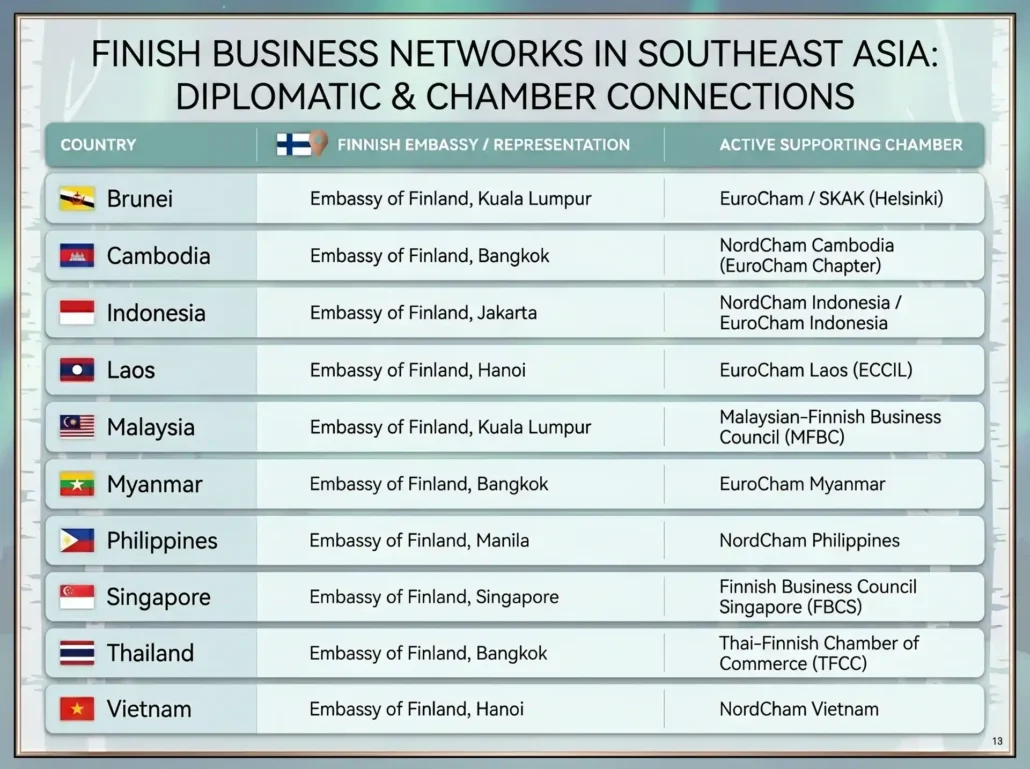
Finnish diplomatic and chamber networks across the ASEAN region.
Pillar 3: Securing Billable Local Expertise for Operational Execution
The third structural pillar shifts from diplomatic introductions to on-the-ground operational execution. The stakeholders include local consulting firms, legal advisors, Finnish expatriates, and the established local business community. These entities handle entity setup, regulatory compliance, local hiring laws, and day-to-day friction.
Strategic Advantage: While diplomacy opens initial doors, successful on-the-ground execution requires engaging directly with the local business network’s established intelligence. Chambers of commerce networks organise events where businesses can find stakeholders to match their needs. Rather than navigating regulatory frameworks alone, enterprises can work with regional consultants, legal advisors, and established partners to run efficient, asset-light entry strategies.
Deploying master distributor agreements, technology licensing, or strategic joint ventures helps SMEs scale quickly by building on the logistics and market expertise of local partners. Diplomats open doors and chambers provide vital intelligence, but they will not close deals or navigate local compliance. SMEs must take ownership of relationship-building and explicitly budget for local legal, commercial, and operational execution. The upfront effort is substantial, but real local collaboration is the key to net profit.
The Executive Checklist for ASEAN Expansion
To insulate your expansion from local regulatory friction and accelerate time-to-revenue, leadership must mandate the following steps:
Base selection is deliberate. Executives should differentiate between established financial hubs such as Singapore, the Big Four mass markets, and public-sector priority markets like Vietnam. Your choice of jurisdiction must actively mitigate regional geopolitical risks and comply with fragmented ASEAN data privacy laws.
Leverage subsidised domestic funding through Business Finland, Finnvera, or Finnfund before market entry. In parallel, immediately integrate into local networks like the FinnCham or NordCham to establish peer-to-peer commercial trust that state actors cannot provide.
Do not attempt to navigate ASEAN regulatory frameworks in isolation. Scale rapidly by piggybacking on the established infrastructure of local distributors, system integrators, or joint-venture partners. We need to set aside capital specifically for local legal and operational expertise to address on-the-ground compliance realities.
Success in ASEAN relies on a simple premise. Institutional support provides the entry, but local partnerships sustain the business. Networking and collaboration are core strategic assets, not peripheral tasks. The most sustainable path to net profit is defined by more than technical knowledge. It is found in how effectively you play the ASEAN way.
This playbook was originally produced by Vision Finland and is republished by TFCC.
Written by Antti Rahikainen
Visuals created with AI assistance

About the Author:
Antti Rahikainen is a director and former President of the Thai-Finnish Chamber of Commerce (TFCC). His career spans over four decades, including 31 years based in Asia with a global professional scope across five different countries. Drawing on his background in telecommunications and business development, he represents the TFCC on the JFCCT’s Digital Economy and Sustainable Development committees, focusing on the intersection of digital technology and sustainable growth.
- Andaman Partners: Trade Crossroads of the World: The Strategic Rise of ASEAN’s Exports, https://andamanpartners.com/2025/11/trade-crossroads-of-the-world-the-strategic-rise-of-aseans-exports/
- Bloomberg: ASEAN as the Super Connector, Unlocking regional trade and global growth, https://sponsored.bloomberg.com/article/sc/asean-as-the-super-connector-unlocking-regional-trade-and-global-growth
- International Monetary Fund: World Economic Outlook (April 2026), https://www.imf.org/external/datamapper/NGDP_RPCH@WEO/AS5/SEQ/IDN/MYS/SGP/THA/
- IMF DataMapper: ASEAN-5 GDP Current Prices, https://www.imf.org/external/datamapper/profile/A